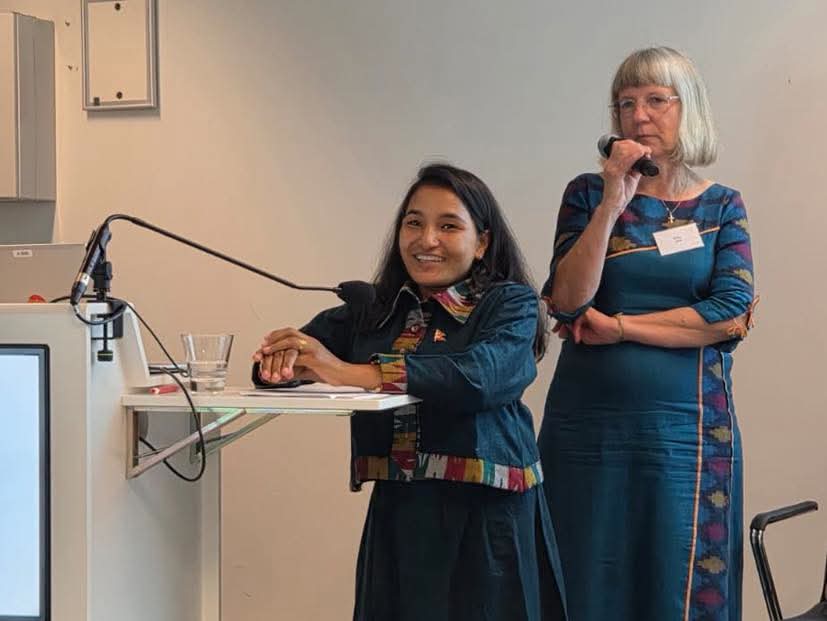
“Working at Felm Nepal has strengthened my belief that everyone, regardless of disability or background, deserves equal opportunities.”
Sabina Parajuli, a Senior Accountant at Felm Nepal, recently visited Finland, where she spoke about the importance of strengthening the agency and participation of persons with disabilities at Felm’s annual meeting, as well as during other speaking engagements.
For Parajuli, the visit was a once-in-a-lifetime experience.
“I felt extremely happy to visit Finland for the first time. I had never imagined that I would have the opportunity to travel to Finland in my life. Therefore, this experience was very meaningful and unforgettable for me.”
Parajuli was born with a physical disability in rural Nepal. Attending school was difficult, as the journey to and from school could take up to two hours each way. She faced discrimination, loneliness, and belittlement from early on in her life. However, the support of her family and her own determination helped her continue her education.
“Getting a place to study in Kathmandu was challenging, as very few people were willing to provide accommodation to a young person with a disability,” Sabina Parajuli explained.
From scholarship student to Felm’s employee
Starting in 2012, she received a scholarship for her bachelor’s studies through a partner organization of Felm Nepal called Forward Looking, which promotes the rights of persons with disabilities, including access to education and employment. Later, in 2016, she secured an internship at Felm Nepal’s office. Today, she continues to work at Felm Nepal as a Senior Accountant.
Looking back, Parajuli says that Felm has played an important role in both her professional and personal development.
“Felm Nepal has helped me become more financially independent, gain new knowledge and skills, build my confidence, and express my ideas more openly. Most importantly, it has strengthened my belief that everyone, regardless of disability or background, deserves equal opportunities.”
Women with disabilities face discrimination
According to Parajuli, the situation of people with intellectual disabilities in Nepal is in many ways even more challenging than that of people with physical disabilities. Their voices are among the least heard in society. Psychosocial disabilities also carry significant stigma in Nepal.
She notes that women with disabilities continue to face multiple forms of discrimination.
“Their access to education, employment, healthcare, economic opportunities, and decision-making processes remains limited. They are often judged based on their physical condition rather than their abilities and contributions.”
At Felm’s annual meeting in Finland, Parajuli encouraged participants to reflect on what they could do in their own roles to ensure that persons with disabilities can participate more equally in society.
Felm’s long-term commitment to inclusion
Her visit to Finland also offered a chance to observe a society where inclusion is visible in everyday life.
“I was impressed by the respect Finnish people show toward one another, their calm nature, helpfulness, and inclusive attitude. I was also impressed by equal access to education and healthcare for everyone, the availability of public libraries, and the importance placed on equality, accessibility, nature conservation, and the well-being of citizens.”
Parajuli believes that Nepal still has important work to do to ensure the rights of persons with disabilities.
“The effective implementation of disability-related laws and policies needs to be strengthened. It is also important to ensure the meaningful participation of persons with disabilities in decision-making processes at all levels.”
What makes her most proud of Felm’s work is its long-term commitment to inclusion.
“What makes me most proud of Felm is its commitment to promoting equality, inclusion, and human rights. In particular, the on-the-job training program has provided persons with disabilities with opportunities to develop their skills, access employment, and become more independent.”